


Satellite internet in 2026 looks nothing like the slow, laggy connections of the past. Two giants — SpaceX’s Starlink and Amazon’s Project Kuiper, now rebranded as Amazon Leo — are racing to beam fast broadband from low Earth orbit to every corner of the planet.
For rural households, frequent travelers, or anyone tracking global connectivity, this guide breaks down everything that matters: satellite counts, real-world speeds, pricing, and what comes next for satellite internet in 2026. The shift from towers to orbit is part of a bigger transformation — analysts now discuss space-based backhaul alongside 6G wireless in 2026, since both promise to erase the last dead zones.
Starlink in 2026: The Unchallenged Leader
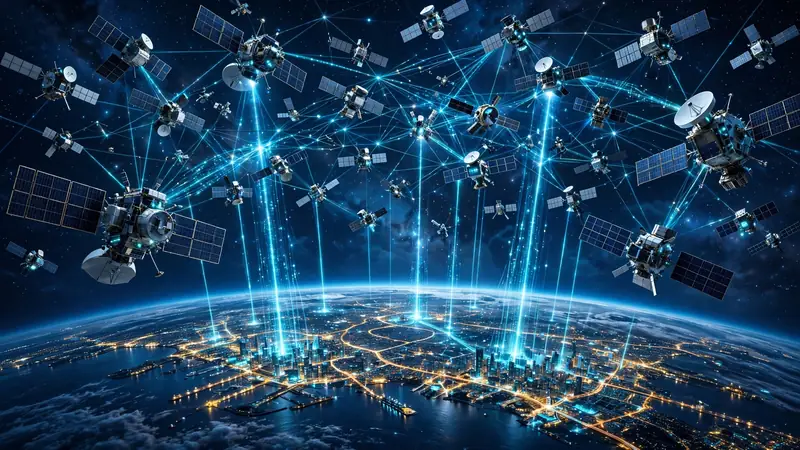
Starlink entered 2026 as the undisputed leader in satellite internet. SpaceX’s October 2026 update puts the constellation at more than 11,000 satellites in low Earth orbit — roughly 25 times its nearest rival’s fleet.
Subscribers and coverage
Starlink reports over 10 million subscribers across 160+ countries and territories. Commercial service since 2020 gave SpaceX years to refine its dishes, network software, and launch cadence.
- Commercial service launched: 2020
- Active satellites: 11,000+
- Reported subscribers: 10 million+
- Countries served: 160+
- Next hardware wave: larger V3 satellites began deploying in late September 2026
Plans and pricing
Pricing varies by country, but in the US Starlink offers tiered residential plans starting at $55 per month for a 100 Mbps tier, stepping up to $85 and $130 for faster options, according to an October 2026 independent comparison. Hardware costs $349 outright or about $10 per month as a rental, and every residential plan is month-to-month with no contract. Pairing the dish with one of the best portable power banks in 2026 also keeps the whole setup running through power cuts and off-grid trips.
Real-world speeds
Independent tracking puts typical Starlink downloads between 25 and 220 Mbps with latency of 25–60 milliseconds — the real breakthrough, since old geostationary services often hit 600 ms and made video calls painful.
Project Kuiper in 2026: Amazon’s New Name, Same Mission
In November 2025, Amazon gave its satellite program a permanent consumer brand — Amazon Leo — retiring the “Project Kuiper” codename.
Satellites in orbit
By October 2026, Amazon had roughly 390–400 Leo satellites in orbit — the third-largest constellation in space, but still dwarfed by Starlink. That same month it produced its 1,000th satellite in Kirkland, Washington — but building satellites and launching them are two different problems, and Amazon has not launched one since July 2, 2026.
Launch roadblocks
Amazon booked more than 100 launches, but its main rocket partners have struggled: ULA’s Vulcan has been grounded since a February 2026 booster failure, and Blue Origin’s New Glenn damaged its pad in a May 2026 test. Amazon is now buying extra launches from SpaceX — its direct rival — which shows how serious the bottleneck is.
Regulatory deadline
The FCC originally required Amazon to deploy half of its 3,236-satellite first-generation constellation by July 30, 2026. Amazon missed that target by a wide margin and, in June 2026, the FCC waived the milestone rather than revoke the license. The company is seeking a formal 24-month extension while it ramps launches back up.
When can you buy it?
Leo remains enterprise-beta only, with a free consumer waitlist. Amazon says commercial service begins before the end of 2026 and considers its current fleet enough for an initial rollout. Consumer pricing is unannounced — analysts speculate $50–$100 per month, but that is speculation until Amazon publishes numbers.
Satellite Internet 2026 Speed and Price Comparison
Here is where the two services stand side by side as of October 2026. Starlink’s figures are live and verifiable; Leo’s are company targets and should be read as promises, not facts. Amazon claims its Leo Ultra terminal could reach 1 Gbps, but no public speed test exists yet — treat Starlink’s verified 25–220 Mbps as the only proven number in this race.

| Feature | Starlink (SpaceX) | Amazon Leo (Amazon) |
|---|---|---|
| Satellites in orbit (Oct 2026) | 11,000+ | ~400 |
| Constellation authorized | 12,000 (Gen1) | 3,236 (Gen1) |
| Subscribers | 10 million+ | Pre-launch (waitlist only) |
| Service status | Live since 2020 | Enterprise beta; consumer launch targeted late 2026 |
| Typical download speeds | 25–220 Mbps (tiers up to 400 Mbps) | Target up to 1 Gbps (unverified) |
| Latency | 25–60 ms (real-world) | Under 30 ms (target) |
| Monthly price (US) | From $55 | Not announced |
| Hardware cost | $349 | Under $400 (target) |
| Coverage | 160+ countries | Pending launch |
| Orbital altitude | 340–570 km | 590–630 km |
Both networks fly in low Earth orbit — a few hundred kilometers up instead of 35,000 km like old satellite TV birds — which is what cuts latency from a painful half-second to a few dozen milliseconds.
How Does Satellite Internet Work in 2026?
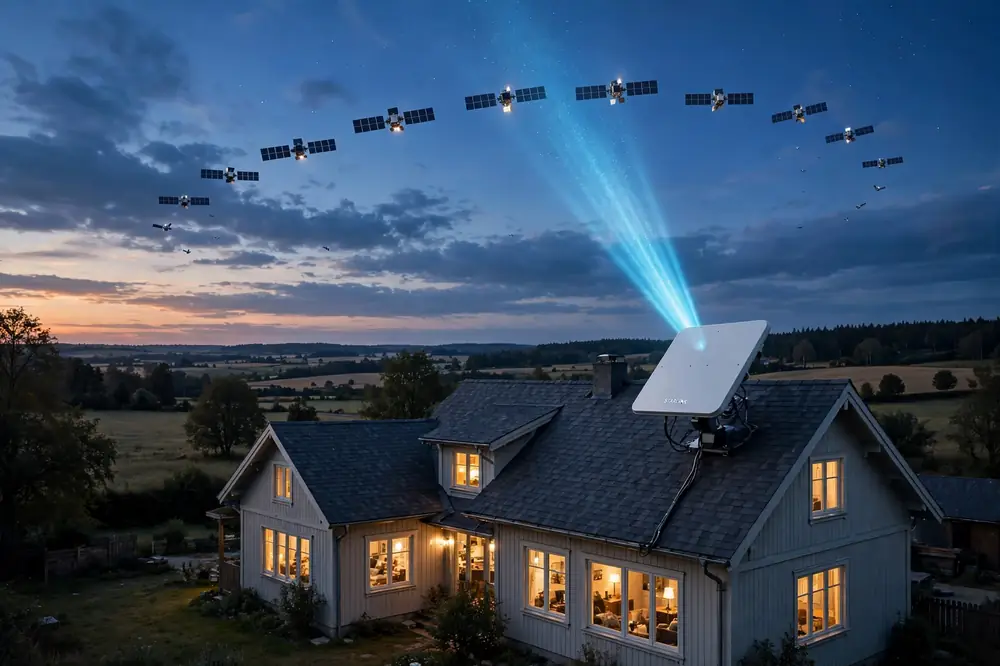
Setup is simpler than most people expect. A flat-panel dish — Starlink’s “dishy,” or Amazon’s Leo Nano, Pro, and Ultra — sits on a roof or in a yard with a clear sky view. It talks to passing satellites, which relay data through the mesh to a ground station wired into the wider internet.
The signal path, step by step
Request leaves your router → dish beams it to the nearest passing satellite → laser links hop it across the constellation → a ground station receives it → fiber carries it to the website’s server → the response travels the same chain in reverse.
Those laser links matter more than most people realize. Early satellites needed a ground station within range of the same satellite serving you; modern ones relay data through space itself, which is why service now reaches ships at sea and research stations. Amazon built laser links into Leo from day one.
What a home setup needs
- Clear sky view — trees and tall buildings are the enemy
- Stable power — the dish draws modest wattage around the clock
- A Wi-Fi router to spread the signal indoors (both vendors bundle one)
- Portable power for off-grid cabins and remote job sites
Which Satellite Internet Service Should You Choose?
The honest answer depends on when you need it. Here is the decision tree for satellite internet in 2026.
Choose Starlink if
- You need internet right now — it is the only LEO service consumers can actually order
- You live in one of the 160+ countries it covers
- You want proven speeds and a mature support ecosystem
Wait for Amazon Leo if
- Your timeline is flexible and you want to compare prices once both are live
- You are an enterprise or aviation customer — Amazon’s beta partners already include airlines and telecom operators
- You are curious whether Amazon’s AWS integration delivers unique features for cloud-connected businesses
The bigger picture
Competition is the real winner here. A credible second network gives Starlink its first genuine rival, which historically pushes prices down and speeds up. For background on how Starlink grew into this position, Starlink on Wikipedia traces the program from its 2015 announcement to the mega-constellation era.
Satellite Internet 2026 FAQs
Is satellite internet in 2026 fast enough for streaming and video calls?
Yes. Starlink’s typical 25–220 Mbps handles 4K streaming easily, and its 25–60 ms latency keeps video calls smooth. Amazon Leo has not published verified real-world speeds yet, so Starlink is the only option with proven numbers today.
How much does satellite internet cost in 2026?
Starlink residential plans in the US start at $55 per month plus $349 for hardware (or about $10 per month rental). Amazon Leo has not announced consumer pricing. Prices vary significantly by country, so check the official sites for your region.
Can I buy Amazon Leo internet right now?
Not yet. Leo is in enterprise beta with a free consumer waitlist. Amazon targets a consumer launch before the end of 2026, but no firm date or pricing is published.
Why did Amazon rename Project Kuiper to Amazon Leo?
Amazon adopted it as the permanent consumer brand in November 2025 while moving toward commercial service. The constellation and company structure did not change — only the public name.
Does satellite internet work in bad weather?
Mostly yes. Light to moderate rain or snow barely affects modern LEO dishes, though severe storms can cause brief dropouts. Heavy snowfall can block the dish, but Starlink dishes include a snow-melt heating mode.
Will more competition lower satellite internet prices?
Probably. Starlink has operated without a serious consumer rival since 2020. Amazon’s entry, plus future constellations, should create real price competition for the first time — one of the best reasons to watch this space.
Conclusion
The satellite internet race of 2026 is a tale of two timelines. Starlink is a finished product: more than 11,000 satellites, over 10 million subscribers, and verified speeds that rival cable in rural areas. Amazon Leo is a promise backed by over $10 billion — 1,000 satellites built, enterprise testers on board — but it still has to prove itself in orbit and on the pricing page.
For now, the choice is simple: if you need satellite broadband today, Starlink is the only option on the table. But the gap is finally closing, and when Amazon flips the switch, the resulting competition should mean better speeds, lower prices, and faster innovation for everyone. That is the real story of satellite internet in 2026 — not which company wins, but what their rivalry builds.
