


6G Wireless in 2026: What the 6G Standardization Race Means for You
The phrase 6G wireless 2026 no longer belongs to the rumor mill. By late 2026, the sixth generation of mobile networks has moved past trade-show slogans and into the document-driven world of international standards — with the International Telecommunication Union (ITU) finalizing what 6G must achieve and 3GPP, the body behind the 5G specifications, actively studying the technologies that will power it. First commercial systems are still years away, but 2026 is the year the 6G standardization race quietly became real.
That matters to you even if you have no plans to buy a 6G phone on launch day. The decisions being written into standards now — around energy efficiency, security, and how networks sense the physical world — will shape the devices you buy and the coverage you rely on well into the 2030s. One design principle already stands out: efficiency is being baked into the requirements for the first time, a trend already visible today in flagships, as our roundup of the best battery life phones in 2026 shows.
What 6G Actually Is — and Isn’t
Understanding the 6G wireless 2026 landscape starts with a simple definition: 6G is the sixth generation of mobile network technology, following the roughly decade-long generational rhythm the industry has kept since the days of 2G: vision, research, standards, then deployment. Each generation added something fundamental — 3G brought mobile data, 4G brought mobile broadband, 5G brought massive machine connectivity and low latency. 6G is expected to add networks that are smarter, more sustainable, and able to perceive their surroundings.
Why 2026 Is the Turning Point for 6G Wireless
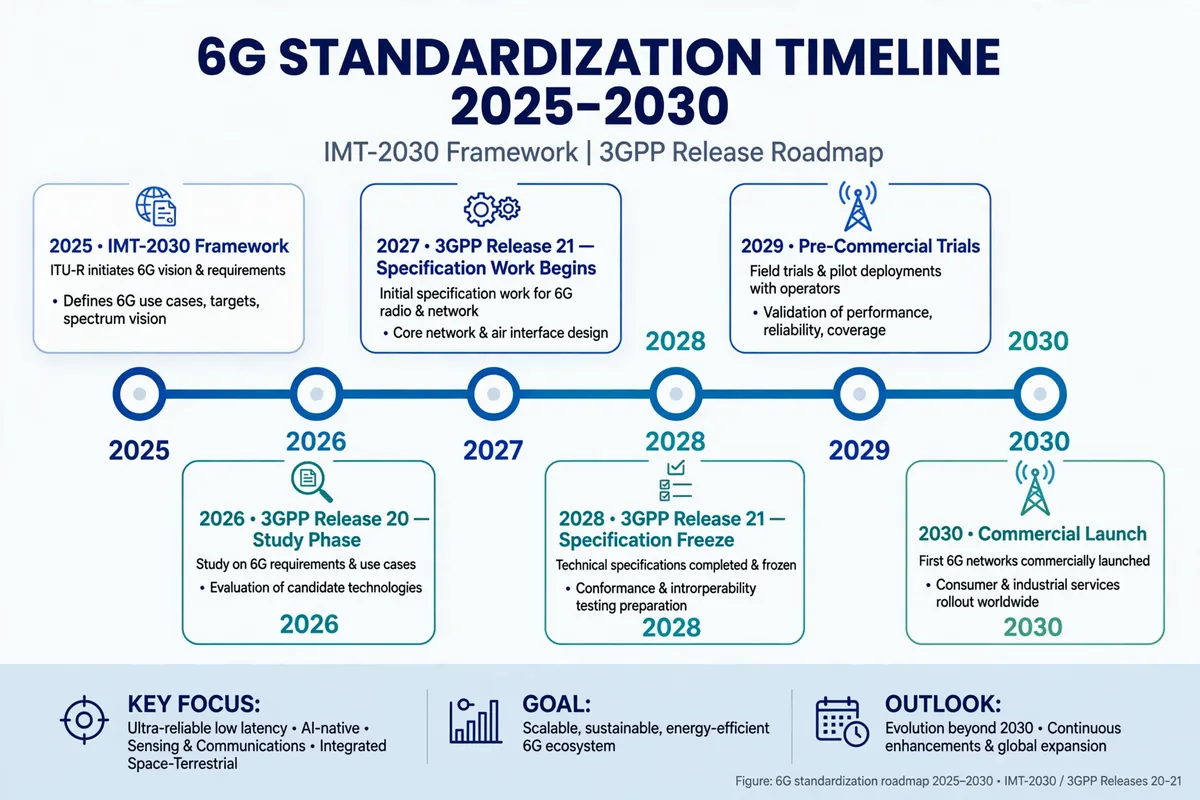
Two 2026 milestones moved 6G from vision to engineering — and they are the reason 6G wireless 2026 is now a standards story rather than a marketing one. In February 2026, ITU-R Working Party 5D agreed on a draft set of 20 minimum technical performance requirements for 6G — the yardstick every future technology proposal will be measured against. In June 2026, the same group completed draft evaluation guidelines, the rulebook for testing candidate radio-interface technologies. Candidate submissions are expected between February 2027 and February 2029.
On the industry side, 3GPP’s Release 20 now serves as the study phase for foundational 6G technologies (while 5G-Advanced work continues in parallel), and its June 2026 plenary approved the RAN-level study on 6G scenarios and requirements plus the Release 21 timeline — which will contain the first normative 6G specifications. In plain terms: the committees have stopped asking what 6G should be and started deciding how to build it.
IMT-2030: The Six Usage Scenarios Defining 6G
For readers keeping track of 6G wireless 2026, the ITU’s framework is the essential reference: the ITU calls its 6G requirements framework IMT-2030 (Recommendation ITU-R M.2160, published December 2023). Where 5G was defined around three usage scenarios, IMT-2030 expands the map to six:
- Immersive communication — extended reality, holograms, and high-fidelity media experiences.
- Hyper-reliable and low-latency communication — industrial automation and other use cases where failure is not an option.
- Massive communication — dense Internet of Things deployments at city scale.
- Ubiquitous connectivity — coverage everywhere, including rural, maritime, and airborne environments; an early taste of this trajectory is visible in wearables that stay connected independently of a phone, like the models in our guide to the best smartwatches of 2026.
- AI and communication (AIAC) — supporting distributed AI workloads and intelligence embedded across the network.
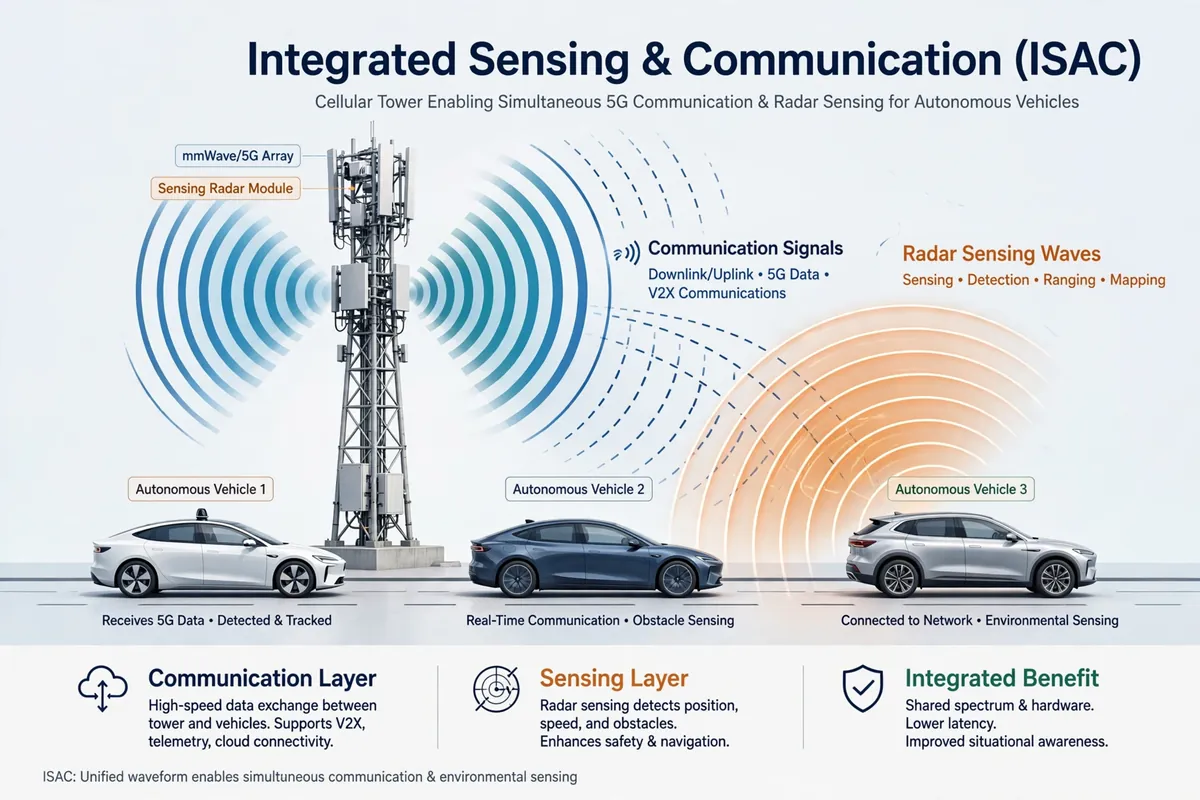
- Integrated sensing and communication (ISAC) — networks that double as distributed sensors, detecting objects, movement, and environments.
The 3GPP Timeline: Release 20 vs Release 21
If the ITU defines the destination, 3GPP writes the turn-by-turn directions. Its release cycle is the mechanism by which research becomes specifications that vendors can build from — and it is the engine room of 6G wireless 2026:
- Release 20 (current study phase): foundational studies of 6G technologies, running alongside continued 5G-Advanced evolution. This is where candidate techniques are analyzed before anyone commits to them.
- Release 21 (first normative 6G specifications): studies conclude in roughly the first half of 2027, specification work runs through late 2028, and a final review lands in early 2029.
Key milestones on the road to launch
- 2026: 6G requirements and evaluation guidelines agreed at the ITU; 3GPP study phase underway.
- 2027–2029: candidate radio-interface technologies submitted and evaluated.
- 2028: possible first demonstration systems or trials — the July 14–30, 2028 Los Angeles Olympics is a plausible showcase window, as earlier generations also debuted at major events.
- 2029–2030: first commercial 6G systems, per broad industry consensus.
Key 6G Wireless Technologies Explained
Four technology directions define nearly every serious 6G wireless 2026 discussion:
Sub-terahertz spectrum
In the 6G wireless 2026 technology mix, sub-terahertz spectrum stands out: above today’s millimeter-wave bands lies the sub-terahertz range, where enormous bandwidths could support extreme data rates — research talk includes peaks up to around 1 Tbps. The trade-off is physics: these frequencies travel short distances and are easily blocked, so expect sub-THz to serve hotspots and short-range scenarios rather than blanket coverage.
Integrated sensing and communication (ISAC)
Perhaps the most genuinely new idea in the 6G wireless 2026 vision: using the same radio signals that carry data to also sense the environment — effectively turning the network into a distributed radar for traffic monitoring, drone tracking, and industrial sensing, running on infrastructure that would be deployed anyway.
AI-native networks
Rather than bolting AI onto an existing network as an optimization tool, the 6G wireless 2026 architecture is being designed with AI as a native citizen of the radio network — managing resources and predicting congestion. This is also where some of the toughest standardization debates are expected, since vendors must agree on how AI-driven functions interoperate.
Non-terrestrial networks from day one
Satellites and high-altitude platforms are being folded into the 6G standard from the start — directly supporting the “ubiquitous connectivity” scenario and the principle of connecting the unconnected.
6G vs 5G and 5G-Advanced: What’s Actually Changing
To be clear about 6G wireless 2026: it is not a pure speed race. The ITU does not center peak data rate the way earlier generations did; instead, the framework balances capacity with sustainability, security, and new capabilities.
| Feature | 5G | 5G-Advanced | 6G (expected) |
|---|---|---|---|
| Peak data rate | ~20 Gbps | ~20 Gbps (refined) | Research targets up to ~1 Tbps |
| Latency target | ~1 ms (URLLC) | ~1 ms, more reliable | Sub-ms for hyper-reliable use cases |
| Key new spectrum | Sub-6 GHz, mmWave | Refinements, NTN intro | Sub-terahertz exploration |
| Usage scenarios | eMBB, URLLC, mMTC | Same, enhanced | Six IMT-2030 scenarios incl. sensing and AI |
| Network intelligence | AI as add-on | AI-assisted optimization | AI-native architecture |
| Sensing | Not in standard | Early studies | Integrated sensing (ISAC) as core scenario |
| Satellite integration | Not in standard | Initial NTN support | Designed in from day one |
What Does 6G Mean for You as a Consumer?
Honest answer: for the average buyer, 6G wireless 2026 changes very little in 2026 or 2027 — and that’s fine. But the standardization decisions being made now will eventually surface in daily life:
- Better coverage in hard-to-reach places: with satellites designed into the standard from day one, dead zones should shrink over time.
- Devices that sip power: efficiency baked into the requirements means future modems and wearables should do more per charge.
- New experiences, not just speed: immersive communication and sensing point to richer XR, smarter vehicles, and environments that respond to you.
- A long, gradual transition: 5G-Advanced keeps improving, and 6G will roll out in phases — you will upgrade into it naturally, not all at once.
What’s Next: 6G Wireless Milestones to Watch Through 2029
The 6G wireless 2026 watchlist continues with concrete checkpoints: the ITU’s candidate technology submissions opening in 2027, the conclusion of 3GPP Release 21 studies around mid-2027, specification work running through 2028, and the final review in early 2029. The signal to watch for is specification maturity, not press releases.
For readers who want the broader technical backdrop, the 6G on Wikipedia entry offers a useful overview of the generations, proposed technologies, and research landscape.
Frequently Asked Questions About 6G Wireless
When will 6G be available?
First commercial 6G systems are broadly expected in the 2029–2030 window, with possible demonstration systems or trials around 2028. Standardization — the prerequisite — runs through early 2029 with 3GPP Release 21, keeping the 6G wireless 2026 timeline on track.
Is 6G just about faster speeds?
No — and that’s a deliberate choice. While research targets include peak rates far beyond 5G, the ITU’s IMT-2030 framework does not center peak data rate. Sustainability, security, sensing, and AI integration carry comparable weight — a philosophy that sits at the heart of 6G wireless 2026.
Will I need a new phone for 6G?
Yes, eventually. 6G wireless 2026 devices will use new radio interfaces and spectrum, so existing 5G phones will not support them. But with commercial service years away, there is no reason to delay a phone purchase in 2026 while waiting for 6G.
What is the difference between Release 20 and Release 21?
Release 20 is the study phase: 3GPP analyzes foundational 6G technologies and scenarios. Release 21 will contain the first normative 6G specifications — the actual technical documents vendors build products from. This study-then-specify rhythm is how 6G wireless 2026 moves from research to reality.
Will 6G replace 5G immediately?
No. Generational transitions are gradual — 5G-Advanced continues to evolve alongside 6G development, and 6G will deploy in phases starting with select markets and use cases, just as 5G did. That gradual cadence defines 6G wireless 2026 as much as any single technology.
Final Thoughts on 6G Wireless in 2026
2026 will be remembered as the year 6G got serious — the defining chapter of the 6G wireless 2026 story: draft requirements, an evaluation rulebook, and an approved study timeline mark the point where 6G stopped being a vision deck and started becoming engineering. The most encouraging sign is not a speed figure but a shift in priorities — energy efficiency, security, and connecting the unconnected are now core design principles. Watch the 2027 submission window and Release 21 milestones: that’s where the 2030s network will be decided.
