


For decades, quantum computing was the technology that was always “ten years away.” In 2026, that excuse is wearing thin. Quantum computing in 2026 looks less like a physics experiment and more like an engineering program: companies publish qubit counts, error rates, and fault-tolerance deadlines like chip makers publish roadmaps. This is TechJara’s quantum computing 2026 briefing — the machines, the milestones, and what comes next.
This is the year the field stopped chasing raw qubit counts and started chasing reliability. That shift matters for everything from drug discovery to encryption — and it connects to the wider frontier-tech race, from satellite internet in 2026 to the 6G wireless in 2026 standardization battle. Here is what quantum computing 2026 has actually achieved, who is ahead, and what comes next.
Quantum Computing 2026: What Is It Really?
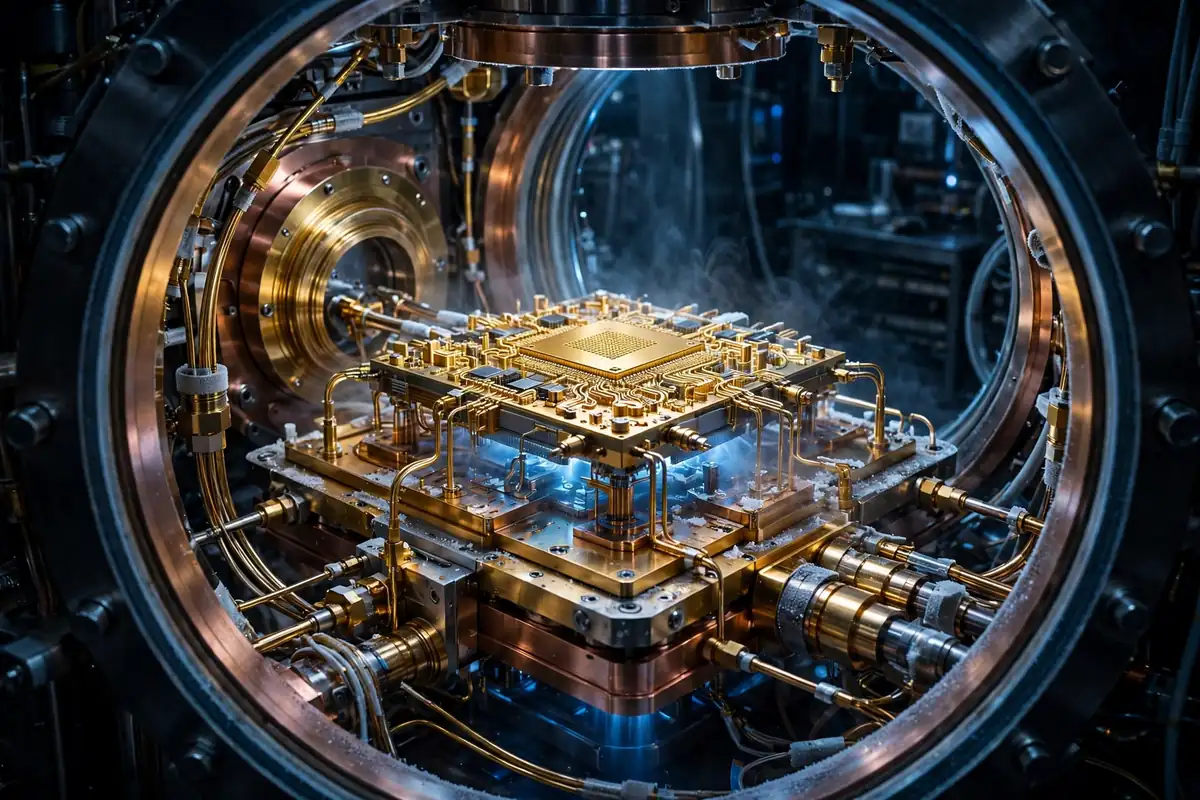
A classical computer stores information as bits — ones and zeros. A quantum computer stores it as qubits, which exploit superposition and entanglement to explore many possibilities at once. In theory, that lets a quantum machine solve certain problems — simulating molecules, breaking RSA encryption, optimizing vast networks — exponentially faster than any classical computer.
In practice, qubits are fragile. Heat, vibration, or stray electromagnetic noise corrupts them — a problem called decoherence. Most of quantum history has been a fight against that noise, and the defining story of quantum computing 2026 is that fight finally turning in the engineers’ favor, through error correction that builds reliable logical qubits out of noisy physical ones.
Google Willow: Below-Threshold Error Correction
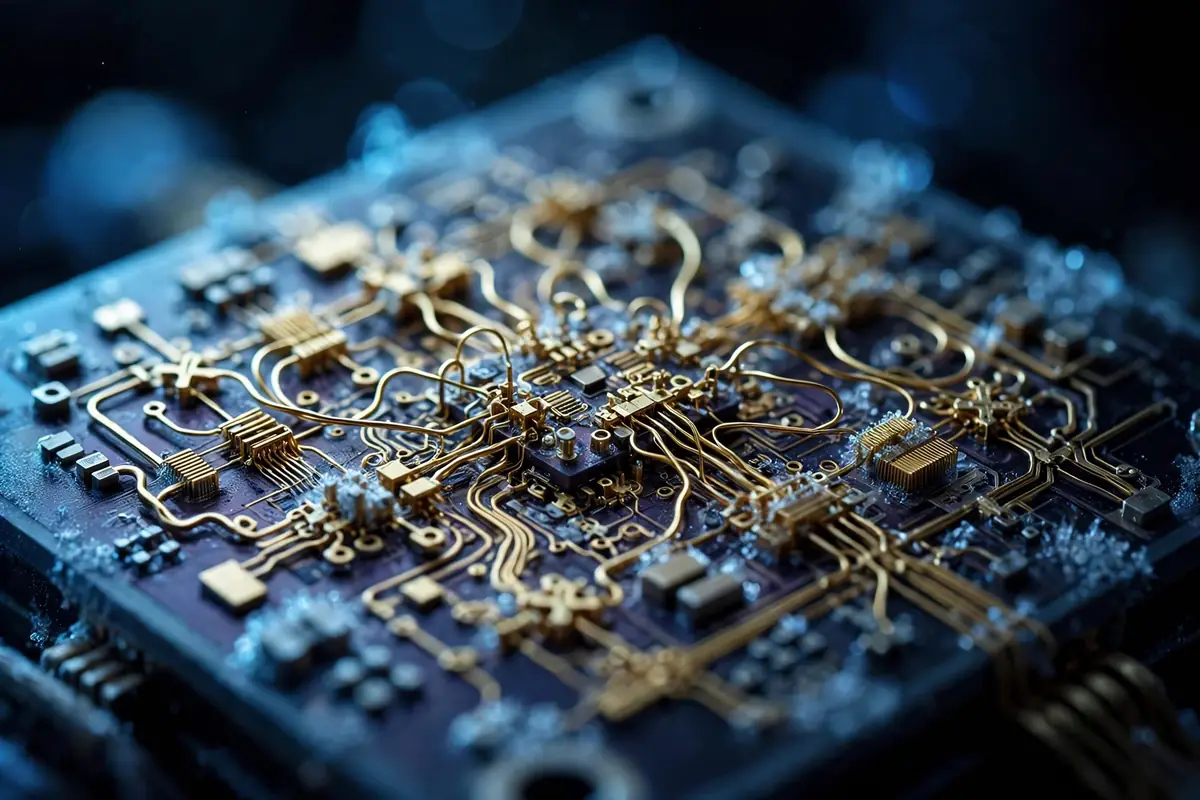
In December 2024, Google Quantum AI unveiled Willow, a 105-qubit superconducting chip, and reported the first “below threshold” demonstration of quantum error correction in a Nature paper. Scaling the error-correcting code from a 3×3 to a 5×5 to a 7×7 grid of physical qubits cut the logical error rate roughly in half each time — the exact opposite of the old pattern, with the corrected logical qubit outliving the physical qubits beneath it.
The 105-qubit Willow chip
Willow is built from superconducting circuits chilled near absolute zero. On a random circuit sampling benchmark, it ran a calculation in under five minutes that Google estimated would take the fastest classical supercomputer 10 septillion (10²⁵) years. Such supremacy-style benchmarks are contested — but the error-correction result was peer-reviewed, and it stands as the field’s biggest conceptual win.
Quantum Echoes and the five-year horizon
In October 2025, the team followed up with “Quantum Echoes,” also published in Nature: a roughly 13,000-fold speedup over the best classical method on a 65-qubit experiment deliberately designed to be verifiable on smaller instances. In October 2026 came a Science paper on magic state cultivation with 99.99% T-state fidelity. Google’s stated horizon: materials, medicine, and energy applications possible only on quantum computers within five years.
IBM’s Quantum Roadmap: Heron, Starling and Blue Jay
Nobody publishes a more transparent roadmap than IBM. Its Heron processor family provides up to 156 fixed-frequency programmable qubits alongside tunable couplers, and hybrid workflows pairing Heron with classical supercomputers have demonstrated 50× speedups on molecular chemistry simulations.
- 2026: the first processor to store information in an efficient error-correcting (LDPC) memory. IBM has committed to demonstrating verifiable quantum advantage this year, starting with chemistry.
- 2027: modules that entangle separate chips into a single larger machine, with 1,000+ programmable qubits in modular cryogenic systems.
- 2029: Starling — 200 logical qubits running 100 million quantum operations in the Poughkeepsie data center.
- Early 2030s: Blue Jay — a 2,000-logical-qubit system.
Backing it: a $10 billion five-year investment. In July 2026, IBM publicly ran 70 error-detected logical qubits with circuits posted online (a preprint, not yet peer-reviewed), and since October 2026 the company has been in DARPA Stage C testing for its Nighthawk/Loon architecture built on 300mm fabrication.
Quantinuum Helios and the Logical-Qubit Lead
If Google leads on verifiable quantum advantage and IBM on roadmap transparency, Quantinuum leads on the layer that will decide fault-tolerant computing: logical qubits that make fewer errors than the hardware underneath them.
Quantinuum’s Helios is a 98-qubit commercial trapped-ion system. In October 2026, the company reported that Helios reached 99.9995% logical memory fidelity with a distance-7 color code — about five logical errors per million correction rounds, roughly 100 times better than Google’s best published superconducting result. That figure comes from a company preprint, not yet peer-reviewed, so treat it as a claim rather than a verdict.
Earlier, Microsoft and Quantinuum jointly created 12 highly reliable logical qubits using trapped-ion hardware plus Microsoft’s qubit-virtualization software, executing end-to-end chemistry simulations with error rates about 22× lower than the underlying physical qubits. Quantinuum also reported a Nasdaq listing in June 2026.
Microsoft, IonQ and the Other Contenders in 2026
The race is wider than the three biggest names. Other contenders shaping quantum computing 2026:
- Microsoft: announced the Majorana 1 topological device in 2025 and produced a second-generation device in 2026 — the acknowledged wildcard, though the claims remain debated.
- IonQ: the strongest quantum business — over $80 million quarterly revenue in Q2 2026 — with >99.99% two-qubit fidelity and a sixth-generation Superion chip platform.
- QuEra: demonstrated 48 logical qubits with neutral-atom arrays, which crossed 6,100 atoms in 2026.
- PsiQuantum: pursuing the photonic route, a longer-shot but well-funded approach.
Why Error Correction Matters More Than Qubit Counts
Tracking quantum computing 2026 means watching two things at once: raw hardware scale, and whether errors can be tamed as that scale grows. Qubit count no longer decides the race — the better question is how many reliable logical operations a machine can run before noise destroys the computation.
That is why Willow’s below-threshold result mattered more than its 105 qubits, and why Quantinuum’s logical-fidelity records matter more than Helios’s 98 physical qubits. Everything published this year points the same way: adding qubits now reduces logical error rather than adding noise — the precondition for fault-tolerant machines.
Post-Quantum Cryptography: The Security Clock Is Ticking
In 1994, Peter Shor showed that a large enough quantum computer could break widely used public-key cryptography: efficient factorization would compromise RSA, and an efficient discrete-logarithm algorithm would compromise Diffie–Hellman key exchange.
NIST has now finalized post-quantum standards — FIPS 203, 204, and 205 — with mandatory migration clocks before RSA deprecation in 2030. Organizations handling long-lived secrets are migrating now, because encrypted data stolen today could be decrypted by a quantum machine tomorrow. The security timeline is no longer theoretical.
Quantum Computing 2026: Leading Platforms Compared
| Platform | Company | Technology | Headline milestone in 2026 |
|---|---|---|---|
| Willow | Google Quantum AI | Superconducting (105 qubits) | Below-threshold error correction; Quantum Echoes 13,000× speedup |
| Heron | IBM | Superconducting (up to 156 qubits) | Starling roadmap (200 logical qubits, 2029); 70 logical qubits demonstrated |
| Helios | Quantinuum | Trapped-ion (98 qubits) | 99.9995% logical memory fidelity (company claim, preprint) |
| Forte | IonQ | Trapped-ion | >99.99% two-qubit fidelity; $80M+ quarterly revenue |
| Majorana 1 | Microsoft | Topological | Second-generation device; claims still debated |
| Aquila-class | QuEra | Neutral atoms | 48 logical qubits demonstrated |
What Quantum Computing Can Actually Do in 2026
Be skeptical of anyone selling you a quantum revolution today. Current hardware remains largely experimental — demonstrations are scientific milestones, not evidence for near-term deployment, and no one has a large fault-tolerant machine yet.
What exists is real and growing: hybrid workflows, verified error-correction scaling, and logical-qubit chemistry simulations. Seven vendors — AMD, AWS, Google, IBM, IonQ, Microsoft, NVIDIA — have named their first targets: catalysis, battery and materials discovery, drug targets, healthcare, optimization. Breakthroughs are projected 2029–2033, products 2033–2040, with one analysis putting the addressable market at $1.51 trillion a year by 2040.
How to Follow Quantum Computing 2026
Watch the milestones that move the needle: peer-reviewed error-correction papers, logical-qubit counts with published error rates, and roadmap deadlines companies stake reputations on. For the fundamentals, the quantum computing article on Wikipedia is a solid starting point. Track IBM’s promised 2026 advantage demonstration, Quantinuum’s 50-logical-qubit push, and Google’s next error-correction scaling step.
FAQs
Is quantum computing real in 2026, or still hype?
Real, but narrow. Below-threshold error correction, verifiable physics speedups, and commercial logical-qubit systems are verified. A general-purpose fault-tolerant machine is likely late 2020s at the earliest.
Who is leading quantum computing in 2026?
Google on verifiable advantage and error-correction science, Quantinuum on logical-qubit accuracy, IBM on roadmap transparency, IonQ on revenue and physical fidelity.
Will quantum computers break Bitcoin and encryption?
Not yet — no machine large enough to break RSA or elliptic-curve cryptography exists. But NIST has finalized post-quantum standards (FIPS 203, 204, 205), and migration is underway because stolen data could be decrypted later.
How many qubits does a useful quantum computer need?
Raw qubit counts are misleading. What matters is logical qubits — error-corrected ones — and how many operations they can run. IBM targets 200 logical qubits for Starling in 2029; IonQ targets 1,600 by 2028.
Can I invest in or buy time on a quantum computer today?
Through IBM Quantum, Amazon Braket, and Microsoft Azure Quantum — and several quantum companies are publicly traded. Treat any investment as high-risk: the commercial timeline is measured in years.
Conclusion
Quantum computing 2026 crossed an invisible line. The field’s central question changed from “can it work?” to “how fast can we scale what already works?” Below-threshold error correction, logical qubits with record fidelity, transparent roadmaps to 200-logical-qubit machines, and a ticking post-quantum security clock all point the same way. The era of real quantum machines is no longer theoretical — and the machines of the 2030s are being blueprinted right now.
