


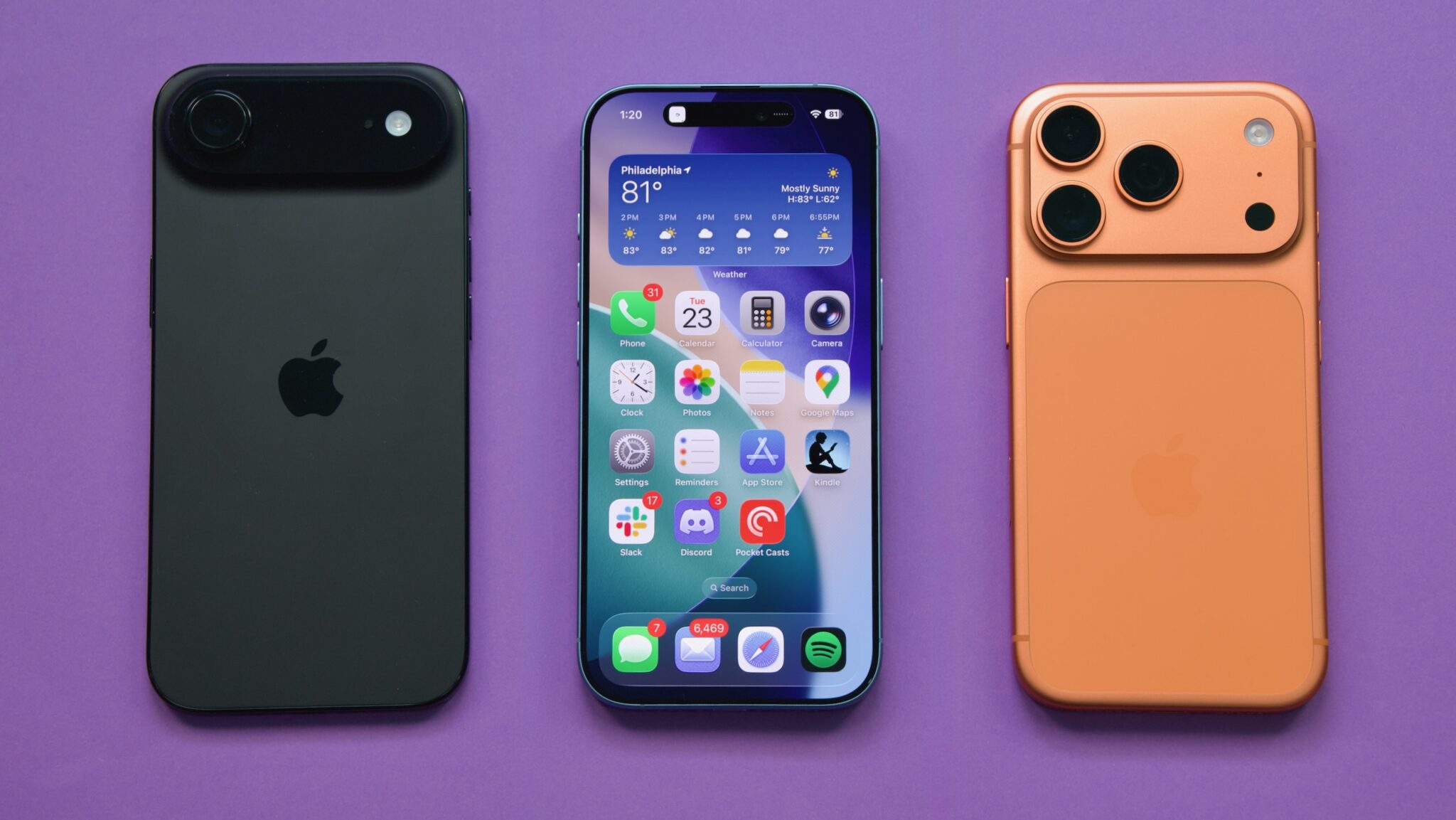
Apple has traditionally kept a noticeable divide between the cameras on its Pro iPhones and those on the standard models. However, many other premium features eventually make their way down the lineup. Edge-to-edge displays with Face ID, the Dynamic Island, OLED screens, and Apple Intelligence support have all reached regular iPhones after spending a generation or two as Pro-only features.
One of the features Apple has taken the longest to bring to its standard models is ProMotion. The company uses this name for displays capable of refreshing at up to 120Hz, compared with the 60Hz refresh rate that was standard on earlier iPhones. While ProMotion isn’t essential, the smoother animations and scrolling have made a noticeable difference since its debut on the iPhone 13 Pro in 2021. The technology also enables features such as an always-on display, giving Pro models another reason to justify their higher prices.
With the iPhone 17, Apple is finally bringing ProMotion to its standard iPhone lineup. That’s several years after many midrange and budget Android phones adopted 90Hz or 120Hz displays. On paper, the upgrade might sound minor, but it makes the iPhone 17 feel significantly more modern. Combined with Apple’s decision to increase the base storage from 128GB to 256GB, the standard iPhone now sits much closer to the Pro models than it has in years.
For longtime Pro users who would rather not pay the premium this year, the iPhone 17 could be an easy step back to the standard model. And if you’ve always considered upgrading to a Pro iPhone but never felt the need to make the jump, there’s even less reason to do so now. You’ll be giving up some advanced camera capabilities and other Pro-specific extras, but you’ll miss far less than you might expect.
The iPhone 17 doesn’t introduce the dramatic redesign of the Pro models or the novelty of the all-new iPhone Air. In fact, much of what it offers has appeared on an iPhone before. Yet that’s precisely what makes it so compelling. By bringing key Pro features to the standard model while improving its storage, Apple has made the iPhone 17 the year’s most meaningful upgrade—and it’s not especially close.
A Design You’ve Seen Before
From the outside, the iPhone 17 looks remarkably similar to the iPhone 16, which itself carried forward the core design Apple introduced with the iPhone 12. Over the past five years, Apple has made only a handful of major changes to the standard iPhone’s exterior. The iPhone 15 brought perhaps the biggest ones, replacing the traditional display notch with the Dynamic Island and swapping the Lightning connector for USB-C.
The iPhone 12 lineup may also have been the last generation in which the standard iPhone and its Pro counterpart were this closely matched. Both models shared essentially the same design, processor, and display, with camera upgrades and the larger Max version providing most of the meaningful differences.
That same formula largely applies to the iPhone 17 and iPhone 17 Pro. They look and feel like members of the same family, sharing much of the underlying design while Apple reserves the more substantial camera hardware and other premium features for the Pro model.
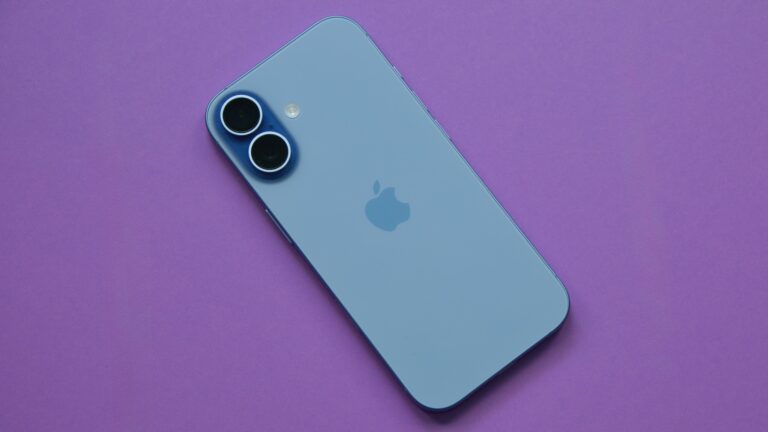
The iPhone 17’s design has received just enough of a refresh that accessories from older models won’t quite fit. You’ll need a case and screen protector specifically made for the iPhone 17, even though the difference is subtle—the phone is only marginally taller than the iPhone 16. The display has also grown from 6.1 inches to 6.3 inches, matching the size of the iPhone 17 Pro. Beyond those changes, however, the familiar aluminum-frame-and-glass construction remains largely intact. Compared with the dramatically slimmer iPhone Air and the more substantial Pro models, the standard iPhone 17 is a much more conservative update.
The display is where the iPhone 17 makes its biggest leap forward. For the first time, the standard iPhone gets 120Hz ProMotion along with the always-on display feature previously reserved for the Pro lineup. According to Apple’s specifications—and based on how the screens look in everyday use—the iPhone 17 and iPhone 17 Pro appear to share essentially the same display technology. Both offer a 2622 × 1206 resolution, extremely high contrast, and impressive brightness levels: 1,000 nits for typical use, 1,600 nits for HDR content, and up to 3,000 nits outdoors under bright sunlight.
It’s easy to label the standard iPhone as Apple’s “budget” model simply because it costs less than the other new iPhones. But at $799, the iPhone 17 is firmly a premium smartphone. Meanwhile, Google and Samsung have been offering OLED displays with 90Hz or 120Hz refresh rates on considerably cheaper phones for years. From that perspective, Apple is undeniably late to the party. It also makes the lack of a high-refresh-rate display on the $600 iPhone 16e harder to justify. Still, there’s a positive takeaway: Apple has added the feature without raising the iPhone 17’s starting price compared with last year’s iPhone 16.
In your hand, the iPhone 17 feels much like other standard-sized iPhones from the past several years. It avoids the ultra-thin design and impressive screen-to-weight ratio of the iPhone Air, while also skipping the extra weight and oversized camera bump found on the iPhone 17 Pro. There’s nothing particularly distinctive about its shape or feel. In many ways, the phone is exactly what its appearance suggests: familiar, straightforward, and intentionally unremarkable.
Camera

iPhone 15 Pro, main lens, 1x mode, outdoor light. If you’re just shooting with the main lens, the Air and iPhone 17 win out in color and detail thanks to a newer sensor and ISP.Andrew Cunningham


Left: The iPhone Air’s camera in its regular 1x shooting mode.Andrew Cunningham
Right: The iPhone 17. It and the iPhone Air have the same main camera and should produce near-identical photos in most conditions.Andrew Cunningham













The iPhone Air features a single camera that shares both the same specifications and sensor as the iPhone 17’s main camera. We’ve already covered how this camera performs compared with the iPhone Pro and the iPhone 15 Pro from a couple of generations ago, so the results are fairly well established.
As with recent iPhone models, the iPhone 17’s primary camera uses a 48-megapixel sensor but typically produces 24-megapixel photos. Apple achieves this through a process known as pixel binning, combining and selectively using sensor data to create smaller images while maintaining a balance between detail and image quality.
The camera also supports a 2x “optical-quality” telephoto mode. Rather than digitally enlarging the entire image, Apple crops a 12-megapixel section from the center of the 48-megapixel sensor. Because the image comes directly from the sensor without additional resizing or pixel binning, the result is still a native-resolution photo without traditional digital zoom.
Image quality at 2x is slightly below what you get from the standard 1x camera, but the difference isn’t dramatic. In fact, the 2x mode on the iPhone 17—and the iPhone Air—can sometimes capture more fine detail than an older iPhone Pro when photographing nearby subjects. That’s because the crop uses the main sensor directly, allowing it to outperform an older dedicated telephoto lens in certain close-range situations.

The iPhone 15 Pro. When you shoot a nearby subject in 2x or even 3x mode, the Pro phones give you a crop of the main sensor rather than switching to the telephoto lens. You need to be farther from your subject for the phone to engage the telephoto lens. Andrew Cunningham


Left: 2x shooting mode on the iPhone Air. We’re still comparing main sensor to main sensor here, so the Air can actually produce better results than a slightly older Pro phone.Andrew Cunningham
Right: The iPhone 17. Same deal as the Air.Andrew Cunningham




One improvement to the iPhone 17’s camera sensor this year is that the ultrawide camera is also upgraded to a 48 MP sensor so that it can benefit from the same shrinking-and-pixel-binning strategy Apple uses for the main camera. In the iPhone 16, this secondary sensor was still just 12 MP.


Left: Here’s where the older iPhone 15 Pro’s actual telephoto lens still provides benefits. Detail in 3x mode is slightly sharper because the iPhone Air has shifted over to digital zoom.Andrew Cunningham
Right: The iPhone Air, 3x mode, with digital zoom.Andrew Cunningham


Left: The iPhone 17 Pro’s telephoto lens in 4x mode.Andrew Cunningham
Right: The iPhone Air, 4x mode, with digital zoom. Note the softer detail.Andrew Cunningham


Left: The iPhone 17 Pro in its 8x mode, which loses the benefits of pixel binning but is still a native-resolution photo from the 48 MP telephoto sensor.Andrew Cunningham
Right: The iPhone Air in 8x mode, digital zoom. It doesn’t totally fail to capture detail, but it’s visibly blurrier than the Pro at this point. The Pro does a great job even at this distance with fine details like the hairs; the Air renders them indistinctly, when it captures them at all.Andrew Cunningham
Compared with the iPhone 15 Pro and iPhone 16, the iPhone 17’s wide-angle shots primarily benefit from the additional detail made possible by its higher-resolution 24MP and 48MP images. The improvement is most apparent in background elements rather than objects in the foreground, where the difference can be easier to spot when examining fine details around the Lego castle surrounding Lego Mario.
The advantages become more obvious when comparing the iPhone 17 with older devices. Improvements to the camera sensor and image processing give newer models an edge in preserving small details. For example, the dust and battle-worn marks on Mario are noticeably clearer in photos taken with the iPhone 17 than with the iPhone 15 Pro.
However, the difference between the iPhone 16 and iPhone 17 is much harder to spot. Aside from the increase in image resolution, the two phones produce remarkably similar results in everyday wide-angle photography.


Left: iPhone 15 Pro, ultrawide lens.
Right: iPhone 16, ultrawide lens.


Left: iPhone 17, ultrawide lens.
Right: iPhone 17 Pro, ultrawide lens.
A true telephoto lens is probably the iPhone 17 Pro’s biggest advantage over the standard iPhone 17, and Apple has made it even more capable this year with a dedicated 48 MP sensor. We’ll reuse the 4x and 8x photos from our iPhone Air review to show you what you’re missing: the telephoto camera captures significantly more fine detail on distant subjects. Still, even as someone who uses the telephoto camera on the iPhone 15 Pro constantly, I’d have to think hard about whether it’s worth spending an extra $300, especially when you also have to weigh the larger battery, ProRAW support, and the other features Apple continues to reserve for its Pro models.
Specs, Performance, and Battery
Our iPhone Air review found that one of the biggest differences between the iPhone 17’s A19 chip and the A19 Pro used in the iPhone Air and iPhone 17 Pro comes down to memory. The standard iPhone 17 has 8GB of RAM, while both the Air and Pro models get 12GB.
The A19 Pro does support additional capabilities, including ProRes video recording and faster 10Gbps USB 3 data transfers. However, many of the Pro-specific features—including the sixth GPU core—are disabled or limited on the iPhone Air. That raises the possibility that the chips are fundamentally the same silicon, with Apple differentiating the models through memory configurations and feature restrictions.
For everyday use, though, the difference is difficult to notice. Apple currently considers 8GB of RAM sufficient for Apple Intelligence, meaning the iPhone 17 has access to the same AI-related features as the iPhone Air and iPhone 17 Pro. Phones with 12GB of RAM may keep more apps and browser tabs active in memory and could have an advantage as software becomes more demanding, but that isn’t a meaningful limitation today.
In fact, 8GB is still relatively generous within Apple’s ecosystem. iOS 26 supports devices with considerably less memory, including models with 6GB, 4GB, and even 3GB of RAM. That makes 8GB more than adequate for the foreseeable future. In everyday use, I couldn’t detect any meaningful performance difference between the iPhone 17 and the iPhone Air.
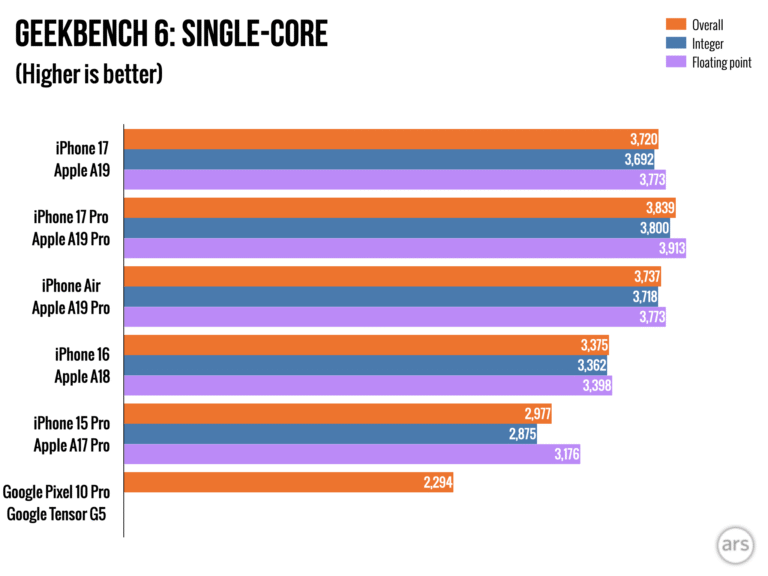
All phones were tested with Adaptive Power turned off.
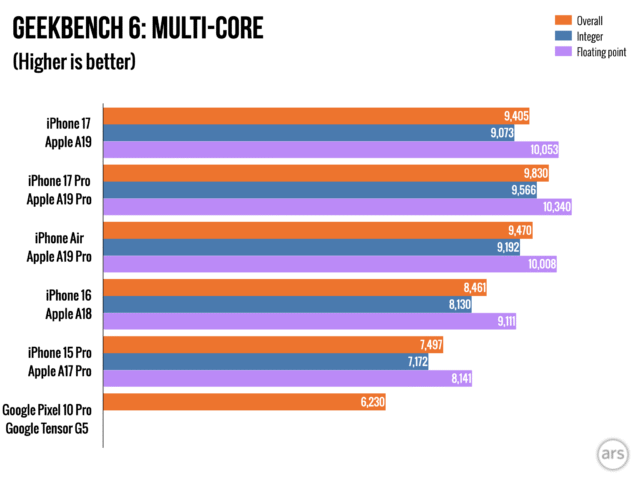
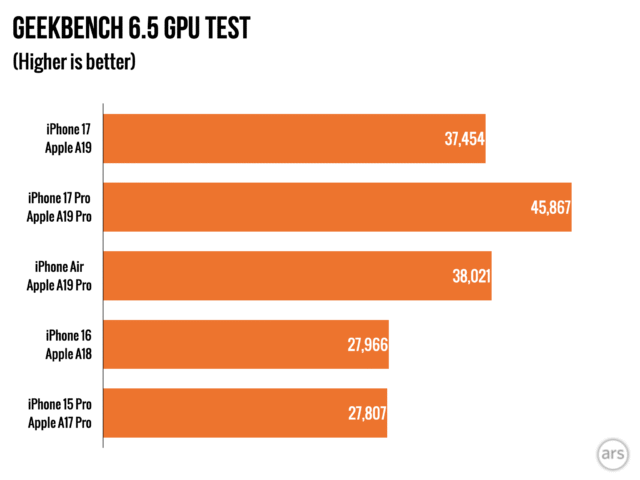
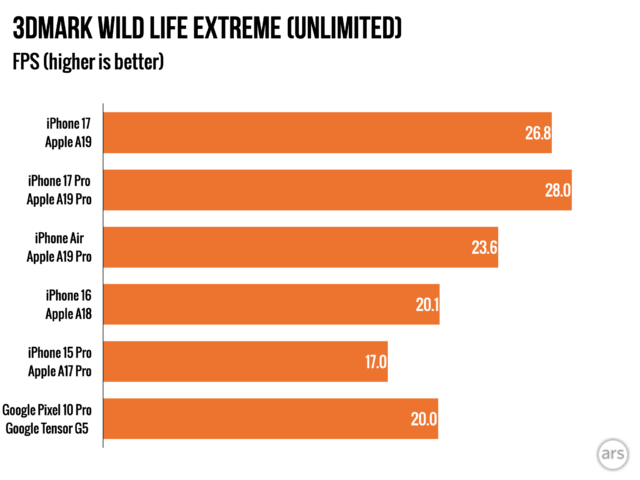
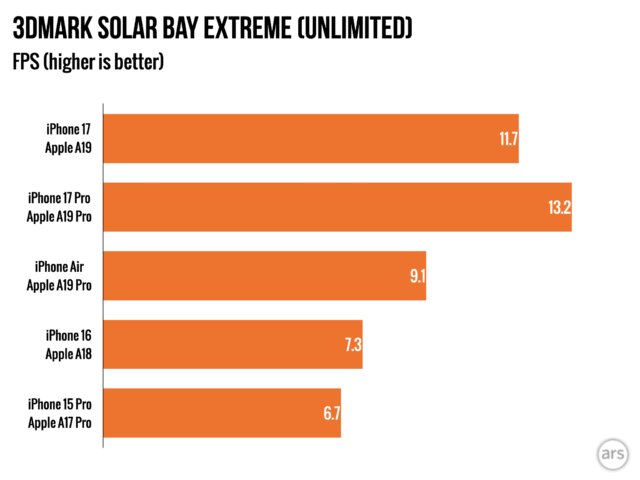
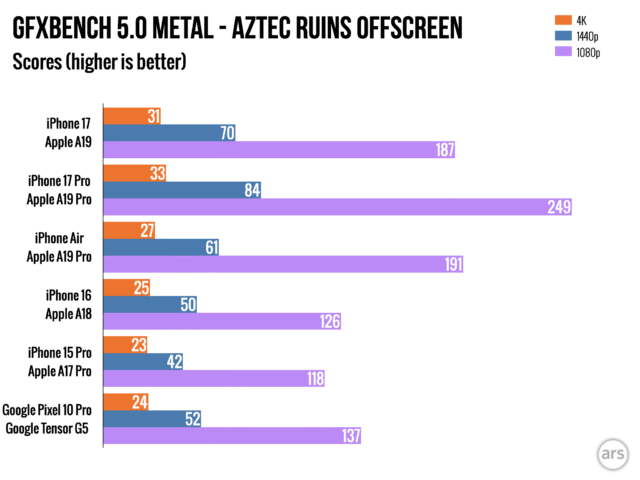
The iPhone 17 is often faster than the iPhone Air, even though both use five-core A19-class GPUs. The Air’s ultra-thin design leaves less room for heat dissipation, so it throttles more aggressively under sustained loads, particularly in demanding 3D games and other graphics-heavy apps. As a result, the iPhone 17 can outperform Apple’s $999 phone while costing $200 less.
That performance advantage is only part of the iPhone 17’s appeal. It also gets one of the more meaningful internal upgrades: Apple has doubled the base storage from 128GB to 256GB while keeping the starting price at $799, the same price as the iPhone 16. Apple’s notoriously steep $100- or $200-per-tier charges for additional storage and RAM are often among the most frustrating parts of its product lineup, so eliminating that upcharge at the entry level is worth highlighting.
We didn’t run dedicated battery tests, but in everyday use, the iPhone 17 consistently lasted from my usual 7:30 or 7:45 a.m. wake-up until my 1:00 or 1:30 a.m. bedtime with roughly 15 to 20 percent remaining. Even on days when I used Personal Hotspot and spent some time playing Pokémon Go, I never drained it enough to need a midday recharge. Like the other new iPhones this year, the iPhone 17 also ships with Adaptive Power enabled, which can reduce performance or dim the display when necessary and automatically switches on Low Power Mode at 20 percent to help stretch the remaining battery.
Better battery life on day one is useful enough, but it also gives you more headroom as the battery inevitably loses capacity over time. That extra cushion can make a meaningful difference after two or three years of use—something the iPhone Air doesn’t quite offer.
The one to beat
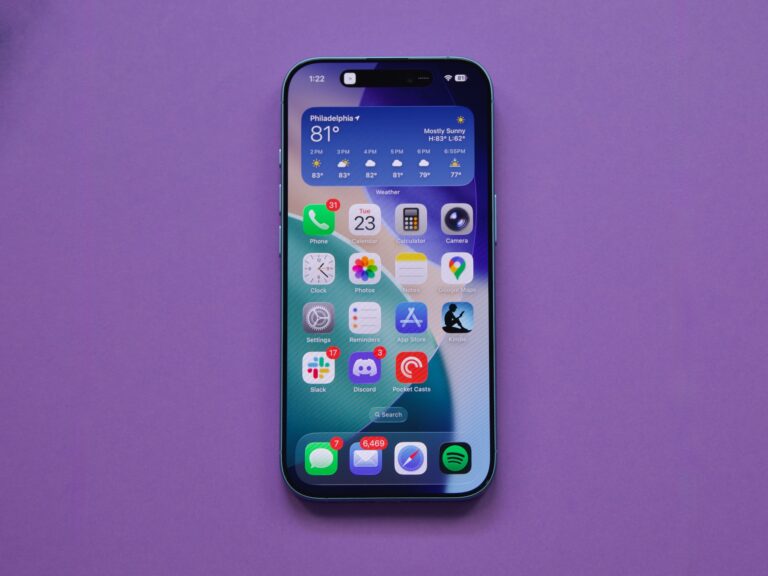
Apple’s iPhone 17. Credit: Andrew Cunningham
The display has long been one of the iPhone Pro’s biggest strengths, and this year the iPhone 17 gets it too. Add in the jump to 256GB of storage, and you have the core of what makes this phone so compelling. For anyone coming from an iPhone 12, 13, or 14, the iPhone 17 should feel like a much bigger upgrade than the iPhone 15 or 16 did. At $799, it’s $200 more than the 128GB iPhone 16e and $100 more than the 128GB iPhone 16, but it’s easily the best value in Apple’s current iPhone lineup.
That’s especially interesting given what Apple has done with the Pro this year. The iPhone 17 Pro gets a noticeably chunkier redesign—one I’m not particularly fond of aesthetically, even if I can appreciate the camera and battery improvements that the extra bulk makes possible. This year, the Pro feels more deliberately aimed at people who actually use their phones for serious photography and videography. In previous generations, it often felt more like a regular iPhone with a collection of nice, broadly useful extras that might eventually make their way down to the cheaper models.
The 2026 lineup therefore feels unusually well segmented. There’s the iPhone Air, which tries to do something genuinely different but makes compromises in areas like camera performance and battery life. Then there’s the iPhone 17 Pro, seemingly designed for anyone who looks at the Air and thinks, “I just want a phone with a bigger battery and a better camera, and I don’t care how it looks or how heavy it is.” Hello, median Ars Technica reader—and employee. And then there’s the iPhone 17, quietly sitting between them and making the much simpler pitch: what if you just want a really good regular iPhone?
Next, and last, on our iPhone review list this year is the iPhone 17 Pro. Maybe spending a few days with it will finally help me appreciate that design.
The Good
- The same excellent display as this year’s iPhone Pro, but $300 cheaper, including 120Hz ProMotion, variable refresh rates, and an always-on display.
- The same capable main camera as the iPhone Air, plus a more versatile upgraded ultrawide camera.
- Strong battery life for everyday use.
- The A19 can sometimes outperform the iPhone Air’s A19 Pro because the iPhone 17 handles heat more effectively.
- Base storage doubles from 128GB to 256GB without an increase in the starting price.
The Bad
- It has 8GB of RAM instead of 12GB. Eight gigabytes is plenty for now, but having more memory is never a bad thing.
- I prefer the color choices Apple offered on last year’s models.
- There’s still no two-column app layout when using the phone in landscape orientation.
- The dedicated telephoto camera remains a Pro-exclusive feature, and it increasingly looks like Apple intends to keep it that way.
The ugly
- People probably won’t be able to tell you have a new iPhone?

1 Comment
Pingback: Best Camera Phones in 2026: Top Picks